GUWAHATI, October 15, 2026 | The Brief Social
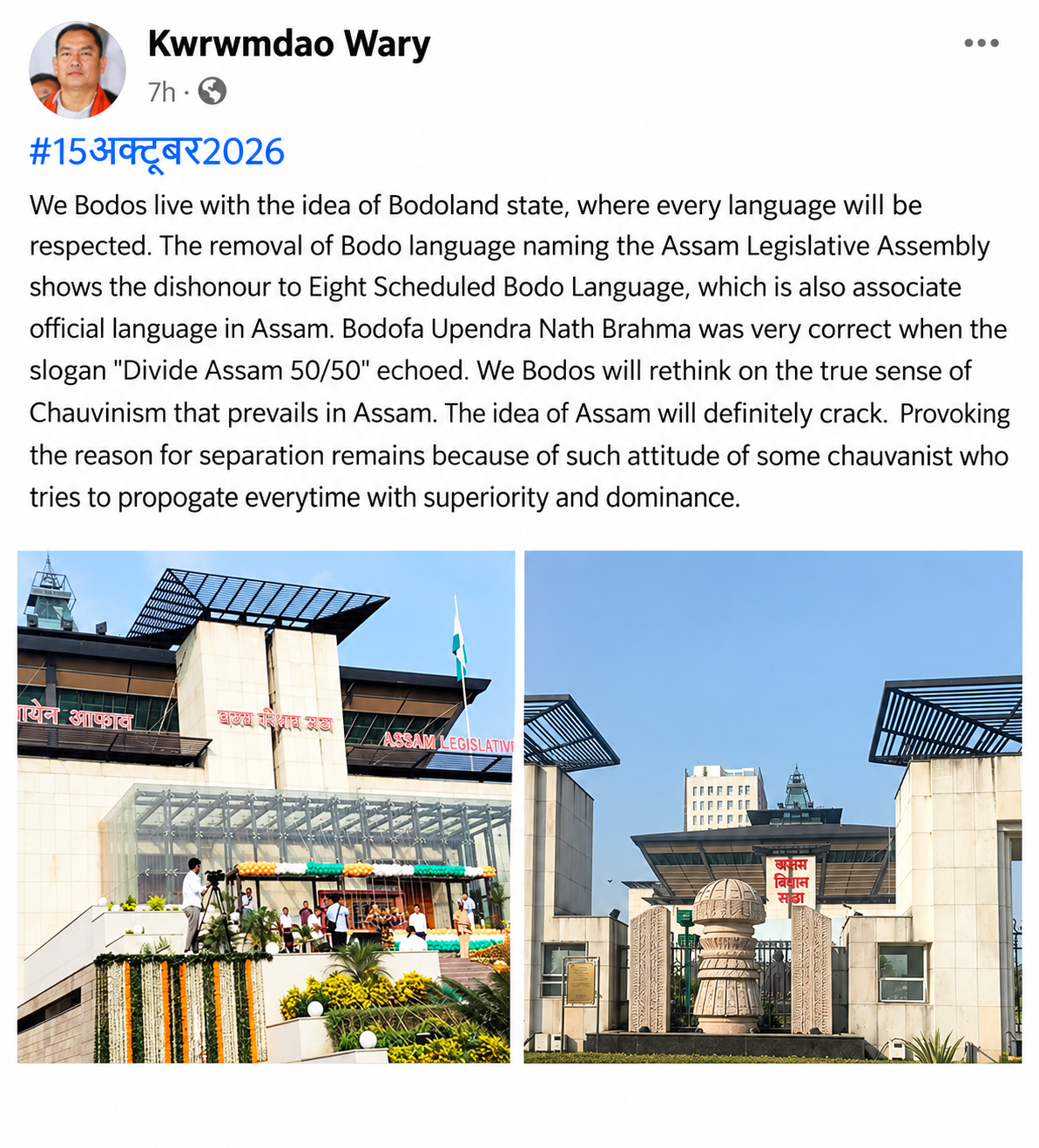
Questions over the representation of the Bodo language at the Assam Legislative Assembly have resurfaced after the president of the All Bodo Students’ Union (ABSU) shared photographs on Facebook that appear to show a difference in the building’s inscriptions.
The photographs, captioned “Then” and “NOW”, show two views of the Assembly complex. In the earlier photograph, Bodo script appears on the central section of the building. In the other photograph, Assamese lettering is visible in that area, while the Bodo inscription does not appear to be present in the same location.
The images have renewed attention to the controversy surrounding the reported removal of Bodo-language elements from the Assembly’s official emblem earlier this year.
Background: The July 2026 controversy
The issue attracted attention in early July after reports of a possible removal of Bodo from the Assembly’s emblem prompted objections from Bodo organisations and protests in Kokrajhar.
On July 5, Assembly Speaker Ranjeet Kumar Dass announced that Hindi would be introduced alongside Assamese, English and Bodo in the Assembly. Chief Minister Himanta Biswa Sarma subsequently stated that there was no proposal to withdraw Bodo from Assembly proceedings or other official business.
The Speaker also clarified that Bodo would remain on the Assembly’s emblem. Nevertheless, concerns continued among some Bodo representatives regarding the language’s visibility and representation within the legislature.
What do the photographs show?
The photographs raise an important question: has the Bodo-language inscription on the Assembly building changed since the earlier image was taken?
The apparent difference warrants clarification from the Assembly Secretariat. However, the images alone do not establish when the change occurred, whether it was officially authorised, or whether it relates to the Assembly’s formal emblem.
Building signage, an institution’s official emblem and the languages used in legislative proceedings are distinct matters. Establishing what changed, when it happened and why is essential to understanding the issue accurately.
Why Bodo-language representation matters
Bodo is included in the Eighth Schedule of the Constitution of India and holds an important place in Assam’s linguistic and cultural landscape.
For the Bodo community, recognition of the language in public institutions carries significance beyond inscriptions on a government building. It is connected to cultural identity, representation and the recognition of linguistic diversity in governance.
The controversy also highlights the importance of transparent communication when decisions involving language and cultural representation are made. Clear explanations from public authorities can help address community concerns and prevent uncertainty from escalating.
Awaiting official clarification
The Assam Legislative Assembly Secretariat can help resolve the questions raised by the photographs by clarifying whether the signage has changed, when any change occurred and whether it was part of an official decision.
Until an official clarification is available, the apparent difference should be treated as a matter requiring verification rather than conclusive evidence of a formal policy change.
The central question remains: has the Assembly’s visible representation of the Bodo language changed, and, if so, what explains the difference?
The Brief Social | Regional Affairs